
From Exception to Action: Risk-Based Issue Elevation
Under FDA’s Quality Management System Regulation (QMSR), exception handling is no longer about closing deviations—it is about demonstrating risk-based thinking across the product lifecycle. This expectation applies equally to pharmaceuticals, medical devices, and combination products, where disconnected investigations often delay CAPA or trigger avoidable field actions.
The differentiator is how exceptions are understood and elevated. Having a single process to collect, document and closure is imperative in implementing an integrated reporting system for all exceptions
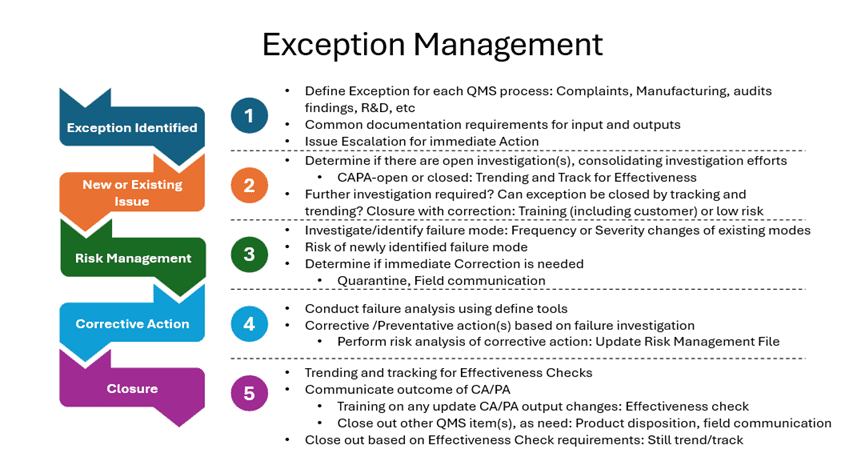
Risk Management as the Decision Engine
Effective exception management begins by placing every failure in context:
- Was the failure previously identified in FMEA, HACCP, or Risk MAP?
- Is this a new hazard or an increased frequency or severity of a known risk?
- What is the impact on patient safety, product performance, labeling, or regulatory commitments?
QMSR reinforces that investigation depth must be proportionate to risk, not event count.
Tiered Investigations Prevent CAPA Overuse
A common, risk-aligned framework supports consistent escalation:
- Level I: Known issue with existing controls, with trending and tracking to monitor acceptable levels
- Level II: Further investigation to determine if CAPA is required
- Level III: CAPA for systemic or high-risk failures
This approach aligns deviations, complaints, stability failures, and post-market signals; a critical requirement for combination products operating across GMP and QMS domains.
Leveraging Prior Knowledge Is a Regulatory Expectation
QMSR emphasizes organizational learning. Elevation decisions must consider:
- Prior investigations and CAPAs
- DHF / product dossier content
- Complaint and deviation trending
- Process and component commonality
Failure to use existing knowledge is increasingly cited during inspections.
CAPA and Field Actions: Evidence, Not Reaction
When CAPA or field action is warranted, risk-based exception management provides defensible justification:
- Severity and frequency trends
- Patient and user impact
- Labeling and clinical considerations
- Cross-functional Quality, Regulatory, and Medical alignment
Field actions become timely and proportional, not reactive.
The Bottom Line
Under FDA QMSR, regulators are not asking if you investigated—but how you decided what mattered. Organizations that integrate risk management, prior investigations, and lifecycle thinking turn exceptions into control points, not compliance gaps.
That is the difference between closing records and protecting patients.
Consult Wing LLC partners with life sciences companies to design, remediate, and sustain robust Quality Management Systems across medical devices, pharmaceutical, biotech, and combination product portfolios. We align regulatory compliance with business objectives to support product lifecycle execution, inspection readiness, and long-term operational performance.
For further discussion on how we can support your organization’s QMS strategy, visit www.ConsultWing.com or contact us directly.